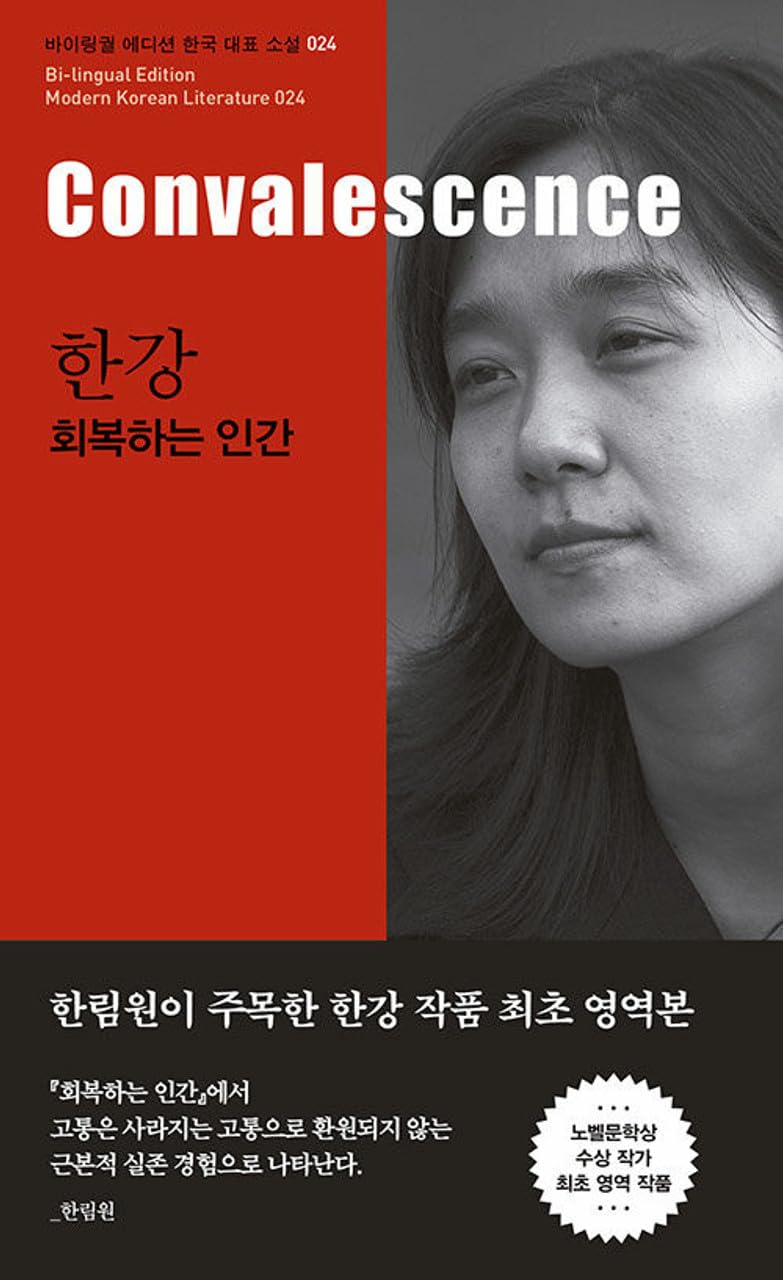
Convalescence - Han Kang 한강 : 회복하는 인간
Bilingual Edition Modern Korean Literature 024
Written by Han Kang
Translated by Jeon Seung -Hee
Edited by K. E. Duffin
Published by Book Publication Asia
한강의 소설에는 언제나 아픔을 간직한 사람들이 그려진다. 이때 그들로부터 강조되는 것은 아픔의 원인아나 그것의 치유 과정이 아니라 오로지 아픔이라는 상황 그 자체이다. 한강의 인물들은 특별한 불행을 경험했다는 이유로 고통의 상황에 노출되는 것은 아니다. 그들은 평범함 인간의 삶에 성공적으로 적응하지 못한 채 삶이 고통 그 자체라는 듯 가까스로 살아가고있다. 우리의 일상적인 삶, 그 삶을 지탱하는 무수한 통념들, 더 나아가 인간이라는 조건 자체가 견딜 수 없는 폭력이라는 듯 한강의 인물들은 생생한 고통의 감각들을 호소하며 섬세한 강인함으로 이 삶을 가로지르고 있다.
Han Kang's stories depict people living in pain. Han emphasizes not the cause of the pain or the process of healing but the pain itself. Characters in Han's stories feel pain not because they have experienced a uniquely unhappy event. Unable to successfully adapt to their everyday lives, they barely manage to live. It is as if living itself is pain to them. As if to say that our daily lives, the numerable socially accepted idears that support those lives, and, furthermore, the condition of being human itself constitue an unbearble violence. Han's charaters complain about their vivid, painful sensations and navigate their lives with a refined fortitude.
한강은 매우 개성적인 숨결로 이채로운 말결을 파동처럼 빚어내는 작가이다. 그 어떤 제재를 다루더라고 자신만의 고집스런 스타일과 상상력, 주제의식으로 오로지 한강만이 빚어낼 수 있는 그윽하고 깊은 파동을 독자들에게 선사한다. 그녀가 다루는 인물들은 대체로 세상의 온갖 허물들을 모아 앓는 자, 상처 깊은 자의 형상을 하고 있다. 상처의 심연으로 내려가서 왜 현존재는 이토록 탈나지 않으면 안 되었던가, 왜 세상은 그토록 고통스럽지 않으면 안 되었던가, 탐문한다.
Han Kang crates idiosyncratic words, breathing life into them uniquely so they ripple outward. No mather what subject matter she deals with, she presents her readers with profound ripples only she can creatre with her own stubborn style, imagination, and subject. Her characters are those who suffer from all the ills of the world, those who are deeply hurt. Delving deeply into their wounds, Han asks and explores why existence has to be such an affliction, why the world has to be so painful.
우찬제 U Chan-je (Literary critic)
■ Table of Contents
회복하는 인간 007
Convalescence
해설 067
Afterword
비평의 목소리 077
Critical Acclaim
작가 소개 086
About the Author
■ Publish Date : 2013-06-15
■ Page & Size : 92p | 4.5 x 7.4 in
■ ISBN : 9788994006826
Han Kang (born 1970) is a South Korean writer.
Life
Born in Gwangju in 1970, Han Kang made her literary debut as a poet in 1993 by publishing five poems including "Seourui gyeoul" (서울의 겨울 Winter in Seoul) in the quarterly Literature and Society. The following year saw her win the Seoul Shinmun New Writer's Contest for her short story "Bulgeun dat" (붉은 닻 Red Anchor). She published her first short story collection entitled Yeosuui sarang (여수의 사랑 Yeosu) in 1995. She participated in the University of Iowa International Writing Program in 1998 with support from the Arts Council Korea.
Her publications include the short story collections, Nae yeojaui yeolmae (내 여자의 열매 Fruits of My Woman), Norangmunui yeongwon (노랑무늬 영원 Fire Salamander); the novels Chaesikjuuija (채식주의자 The Vegetarian), Huirabeo sigan (희랍어 시간 Greek Lessons), Sonyeoni onda (소년이 온다 Human Acts), Huin (흰 The White Book), and Jakbyeolhaji anneunda (작별하지 않는다 I Do Not Bid Farewell); and the poetry collection Seorabe jeonyeogeul neoeo dueotda (서랍에 저녁을 넣어 두었다 I Put the Evening in the Drawer). She has received numerous awards including Today’s Young Artist Award, the Korean Fiction Award, the Yi Sang Literary Award, the Hwang Sun-won Literary Award, the Manhae Literary Award, the Kim Yu-jeong Literary Award, the Man Booker International Prize and the Malaparte Prize.
Work
The works of Han Kang have been enthusiastically received by both critics and readers alike for their profound exploration of human nature through the author’s delicate yet powerful writing style.
As if to say that our daily lives, the limited socially accepted ideas that support those lives, and furthermore, the condition of being human itself constitute an unbearable violence, Han's characters embrace their vivid, painful sensations and navigate their lives with refined fortitude.
The Vegetarian, Han’s first novel to appear in English, is a story in three acts: the first showing protagonist Yeong-hye’s decision and her family’s reaction; the second focuses on her brother-in-law, an unsuccessful artist who becomes obsessed with her body; the third on In-hye, the manager of a cosmetics store, trying to find her own way of dealing with the fallout from the family collapse. Across the three parts, we are pressed up against a society’s most inflexible structures—expectations of behaviour, the workings of institutions—and we watch them fail one by one. The novel repeatedly shows the frictions between huge passion and chilling detachment, between desires that are fed and those that are denied.[1]
Human Acts looks back at South Korean history from 1979 through the 1980s, when there was a dictatorship and assassinations, torture, civil unrest, and the slaughter of protesters. Han focuses on the infamous Gwangju Uprising and personalizes the resulting events through the death of a young boy. By integrating personal stories (based on her family’s experiences) with historical details, Han peels back layers of problems that have not been fully acknowledged or rectified with South Korean society and government.[2]
Han's latest novel, Jakbyeolhaji anneunda, is inspired by the civilian massacre on Jeju Island on April 3, 1948. Gyeong-ha, the protagonist, travels to Jeju at the request of her friend, In-seon. She is confronted with the family's painful past, notably that of In-seon's mother, Jeong-sim, who spent decades trying to find her brother who went missing in the 1948 massacre. The "utmost love" that Han speaks of is first and foremost found in Jeong-sim. But it also travels from Jeong-sim to her daughter In-seon, and from In-seon to her friend Gyeong-ha, neither of whom can escape the grip it has on their lives, despite the agony it entails.[3]
References
[1] Hahn, Daniel. “The Vegetarian by Han Kang Review – an Extraordinary Story of Family Fallout.” The Guardian, 16 Mar. 2018, https://www.theguardian.com/books/2015/jan/24/the-vegetarian-by-han-kang-review-family-fallout
[2] “Human Acts” Dublin Literary Award 2018 Shortlist, https://dublinliteraryaward.ie/books/human-acts/
[3] Lee, Haye-ah. “Han Kang Says New Novel Is about “Utmost Love.” Yonhap News Agency, 7 Sept. 2021, https://en.yna.co.kr/view/AEN20210907007000315
Connect with Han Kang:
https://han-kang.net/Nav-Books
https://han-kang.net/Visual-Arts
https://namu.wiki/w/%ED%95%9C%EA%B0%95(%EC%86%8C%EC%84%A4%EA%B0%80)
https://ko.wikipedia.org/wiki/%ED%95%9C%EA%B0%95_(%EC%9E%91%EA%B0%80)
https://en.wikipedia.org/wiki/Han_Kang
https://library.ltikorea.or.kr/writer/200306
'Echo > e—Han Kang' 카테고리의 다른 글
| Han Kang - 눈물상자 | The Box of Tears (2) | 2026.04.12 |
|---|---|
| Han Kang - 천둥꼬마선녀 번개꼬마선녀| The Little Thunder Fairy and the Little Lightning Fairy (1) | 2026.04.12 |
| Han Kang - 빛과 실 (0) | 2026.04.07 |
| Han Kang - 서랍에 저녁을 넣어 두었다 (2) | 2026.04.07 |
| Han Kang - 여수의 사랑 Yeosu (0) | 2025.01.13 |


